Showing posts with label BUY. Show all posts

Thursday, September 17, 2009

Indonesia’s Government to export 500,000 tons of urea fertilizer


Indonesian Agriculture Minister Anton Apriantono said the government would allocate about 500,000 tons of the country`s urea fertilizer production for export. “We are planning to export 500,000 tons. Confirmation is being made so that the figure will not be less than that,” the minister said after visiting the Cipinang Rice Wholesale Market here on Monday, 14 Sep 09

The minister said he had received a report that there was a stock surplus of one million tons but his ministry would still confirm the report.

In the meantime, Trade Minister Mari Elka Pangestu said that the urea fertilizer export plan would be carried out at the end of the year. “Usually it is done before the end of the year to anticipate the planting season and other things,” she said.

Minister Apriantono said recently that the quantity of fertilizer that could be exported and the time frame for the export were still being discussed. “Just wait for it. We stll need to coordinate the matter with other ministries in the first place,” he said.

Deputy to the chief economic minister for agriculture, Bayu Krisnamurthi said the country had a surplus in fertilizer stocks at present. “There is a surplus in the national fertilizer stocks,” he said.

Based on records, urea exports were usually carried out by PT Pupuk Iskandar Muda with a volume of about 450,000 tons. But the government would give a chance to other companies to carry out the exports.”The ministry of agriculture wants fertilizer stocks to be safeguarded. But on the other hand, it is also considering the interest of industries,” he added.

Tuesday, September 15, 2009

Guide to Fertilizer

Three of the elements necessary for lawn and plant growth are oxygen, hydrogen and carbon. They are available from the environment. Plants also need nutrients that are not as readily available. Nutrients don't stay long in the soil and have to be replenished regularly. Each nutrient plays an important role in plant survival and health. Fertilizer is the means of supplying these nutrients. Lowe's is happy to provide this information as a service to you.

Nutrients

The nutrients are divided into three categories:

* Macronutrients - Nitrogen, phosphorus and potassium are the primary nutrients critical to plant health.


* Secondary nutrients - Calcium, magnesium and magnesium are needed in lesser quantities but are still necessary for optimum plant growth.


* Micronutrients - Boron, chlorine, cobalt, copper, iron, manganese, molybdenum, nickel and zinc round out the list.


Fertilizer Types

Fertilizer is available in two types — liquid and granular. Choose the one that meets your needs in the form that is easiest for you to use:

* Liquid fertilizers are fast-acting. Since they're quickly absorbed, they require application every 2-3 weeks. Most are concentrates, mixed with water prior to application by hose-end sprayer or watering can.

* Granular fertilizers are applied dry and must be watered in. Granular fertilizers are easier to control because you can actually see how much fertilizer you are using and where it is being dispersed. They are normally applied by hand or mechanical spreaders.

Granular fertilizers are produced in two different formulations, quick-release and slow-release.

Quick-release fertilizer typically lasts for three to four weeks, depending upon the temperature and the amount of rainfall. For general use, these water-soluble nitrogen fertilizers (WSN) are also known as commodity or field grade fertilizers.

There are two main types of slow-release fertilizers, known as water-insoluble nitrogen (WIN), available for specific applications:

* Sulfur coated, which lasts for about 8 weeks.
* Polymer coated, lasting about 12 weeks.

Both time estimates may vary depending upon the amount of rainfall.

Reading a Fertilizer Label
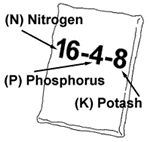

The three numbers (often called NPK) on a fertilizer package tell you the percentage of the primary nutrients' makeup by weight. These percentages in fertilizer compounds are formulated for everything from asparagus to zinnias. The three main components are:

* Nitrogen (symbol N) for leaf development and vivid green color.

* Phosphorous (symbol P) for root growth.

* Potassium (symbol K) sometimes called potash, for root development and disease resistance.

Fertilizer bag example For example, a bag marked "16-4-8" contains 16 percent nitrogen, 4 percent phosphorous and 8 percent potassium.
The other 72 percent is usually inert filler material, such as clay pellets or granular limestone.

To know how much of each is in the bag, multiply the percentage by the size (weight) of the bag. (Example: a 50-lb. bag of 10-10-10 contains 5 pounds each of nitrogen, phosphorus and potassium). There may also be secondary or minor elements in the formula. Don't feel shortchanged by the presence of the so-called inert material in the fertilizer bag. Its purpose is to help distribute the fertilizer evenly and prevent chemical burn.

Plant Foods

Included in the fertilizer family are the general or all-purpose plant foods. In addition to granular or liquid form, they are also available as tablets or spikes.

Plant foods are usually in smaller, more manageable packages for use with houseplants. You will find specially formulated plant foods for indoor plants like African violets, cactus and flowering plants. Generally the formulas are higher in nitrogen for foliage plants and higher in phosphorus for flowering plants.

Plant foods are also available for specific outdoor plants such as roses and acid-loving plants like rhododendron. Spikes and tablets offer a clean, convenient way to feed, especially in containers where nutrients are leached out by watering.

Lawn Fertilizers

Lawns have specific fertilizer requirements, depending on the season and the type of turfgrass you grow. Read the i instructions on the package carefully before purchasing. Lawn fertilizers containing various percentages of nitrogen, phosphorus and potassium are common lawn foods. Fertilizer combined with pesticides are also widely used.

Weed and Feed and Pre- or Post- Emergents

Weed and Feed is a common term which refers to fertilizer that contains weed killer for broadleaf weeds such as dandelions or grassy weeds like crabgrass. Look on the label for a list of weeds that can be treated with the product. The two types are:

* Pre-emergents, such as those commonly used to prevent crabgrass, are weed killers which must be applied before the weeds germinate. They are ineffective if the weeds are already actively growing. Pre-emergent weed killers are often mixed with fertilizer and are applied early in the season.


* Post-emergents are contact killers. They are effective only if the weeds are already actively growing. They will not kill weeds that have not yet germinated.

The timing of application of pre-and post-emergents is critical for success. Applying these products too early or too late is essentially a waste of time. If sowing grass seed is also in your lawn schedule, make sure that there is the proper time interval between applying weed and feed and sowing. Read the package carefully before selecting to be sure which product fits your needs.

Starter fertilizers and winterizers provide extra phosphorus for root growth. Starter fertilizers are applied to provide a boost to newly seeded lawns. Winterizers are used as a last fall feeding to promote off-season root growth.

Organic Alternatives

Non-synthetic organic fertilizers, soil conditioners and soil additives are also widely used. Because they lack some added ingredients to slow the nutrient release, these products may have to be applied more frequently. As with synthetic products, apply properly and with caution. Some of the most commonly used are:

Green sand — from sedimentary marine deposits. Contains potassium and iron.

Blood meal — a byproduct of the meat packing industry. Steamed and dried, it is high in phosphorous.

Compost — one of the best all around garden materials for soil improvement.

Cottonseed meal — a byproduct from cotton processing. This is a good source of nitrogen.

Fish emulsion — a fish processing byproduct. Mild, nontoxic, and organic, fish emulsion is good for use with tender plants that may suffer fertilizer burn. Yes, it does smell like fish.

Super phosphate — rock phosphate combined with sulfuric acid to produce phosphorus in a form easy for plants to uptake.

Manure — for soil conditioning. "Hot" manures such as horse, pig and poultry are high in nitrogen and need composting to prevent burning plants. "Cold" manures like cow, sheep or rabbit can be added directly to the soil.


Maximizing Your Fertilizer Use


Do a Soil Test

Just because the soil looks rich and dark doesn't mean that the nutrients are all there. Soil nutrients can become depleted over time and need a boost. A soil test is the key. The soil test tells you what is already there (so you don't add more), and what is missing. Lime is used for raising pH (make it more more alkaline). Sulfur lowers soil pH (making it more acidic).

Apply Properly

Overapplication of fertilizer is a common occurrence. Too much product applied faster than the plant can absorb it wastes fertilizer and harms the plant.

Always apply fertilizer at the proper time. Do not apply slow-release fertilizer late in the growing season. You don't want to boost foliage growth with nitrogen-heavy fertilizers prior to the dormant season.

Crop Rotation and Intercropping

Each species of plant needs a different mix of nutrients. Rotation of plantings allows you to get the most from your garden soil.

Intercropping is the planting of different varieties within a close vicinity. Using principles of companion planting, intercropping lets plants natural qualities complement each other.

Green Manure

Crops that are planted with the specific intended purpose of being worked back into the soil are known as green manure. These cover crops are chosen for their nutrient value and are used by serious home gardeners as well as commercial agricultural growers.

Fertilizer Safety

Excess product from fertilized areas has to go somewhere. That somewhere is either down into the ground, affecting the water table or running off to affect nearby areas. That runoff could eventually end up in the water supply downstream.

Always follow package directions regarding proper attire, application procedures and safety precautions.

Thursday, September 10, 2009

Fertilizer plant being built


Fertilizer plant being built

At least one local company is not being stifled by a slowed-down economy.
The Dell Rapids Coop Grain is constructing a new dry and liquid fertilizer plant to store bulk fertilizer.
“This allows us faster service to farmers,” said Mark Lee, general manager of Dell Rapids Coop Grain. “We can get to the farmer quicker and we don’t have to wait to fill trucks.”
Todd Brown, who farms west of Dell Rapids, said farmers have a 10-day window to apply the fertilizer. “The fertilizer plant is going to be more helpful to the farmer,” he said. “There is a short time span for spring planting and the fertilizer needs to be applied right before planting. Any speed and capacity with fertilizer application is going to be very helpful to us.”
Mike Wolles, who also farms west of Dell Rapids and is a member of the coop board, said this conveys the message the coop is firmly committed to the fertilizer business for the future. “Crop fertility is going to be more important as farmers continue to find ways to increase yields on their land,” he said. “This commitment is just one more way to help the farmers meet their goals.”
The first six months of 2009 the Coop has seen increased income compared to past years. “The reason for the success is that the farmers have been very supportive,” Lee said. “Without their support, like any other business, we would slowly fade away.”
The new plant will hold 4,000 tons, which is two times larger than the current fertilizer plant. The new 21,000 square foot building replaces one that was built in the 1960s and will be constructed near the West Quarry plant in Dell Rapids. It will also include new technology and will store more fertilizer.
The plant is being built on a piece of property in the Mergen’s Addition. The addition was replatted and included a lot 7, allowing the coop to purchase that piece of property. The Dell Rapids Planning and Zoning Commission and then the Dell Rapids City Council approved rezoning the lot from general business to general industrial, as well as approving a conditional use permit to build the fertilizer plant.

Printer-friendly E-mail

Wednesday, September 9, 2009

ORCHIDS FLOWERS


When fertilizing orchids, a good rule of thumb to remember is “weakly, weekly” (use a weak fertilizing solution once a week) to simulate their natural feeding habits in the wild. Remember, unless they are terrestrials, orchids are usually fed by rain runoff with much diluted nutrients.

You must know which type of fertilizer to use on your orchids. There are fertilizers specially designed for growing orchids, a good one normally having a nitrogen-phosphorus-potassium balance of 7-9-5. However, if you want your plant to flower, there are blossom boosting fertilizers with a formula of 3-12-6 used just before a plant starts forming buds. The combination of nitrogen (N), phosphorus (P), and potassium (K) is good for plants as nitrogen is good for growth, phosphorus elicits blossoms, and potassium fortifies roots. Fertilizers may come in granules, liquids, or spikes.

Here are some fertilizing tips for your orchids:

* It is better to fertilize every other week.
* Mix fertilizer with lukewarm, not cold, water.
* Do not over-fertilize. You’ll notice the plant tips turning black when you do this.
* Do not use fertilized water runoff on another plant as this could spread disease.
* Sick plants should not be fertilized.

HOW TO BUY FERTILIZER????

How to Buy Fertilizer

For a couple of years now, I have presented a talk entitled "You Can’t Get Any Lower Than Dirt!" to gardening groups in the Southeast. I talk about why organic matter is so important to your soil and why adding lime is one of the most important things you can do.

The highlight of the presentation (for me, anyway) is when I select an audience member to help me teach what the numbers on a fertilizer bag mean. As the volunteer nervously stands before the group, I deliver a cockamamie story about how he was once a ‘student’ of John Travolta. I proclaim that my victim is still a closet disco dancer and I invite him to assume the famous pose Travolta made famous in advertisements for "Saturday Night Fever".

One finger in the air, hand clutching a Buzz Lightyear toy; one finger pointed downward, hand grasping an Energizer bunny; his knee encircled by a lace garter, my straight man vows never again to volunteer to help anyone.

Grateful that they were not selected, my audience chuckles as they learn that the numbers on a fertilizer bag stand for "Up - Down - All Around". The pose of the hapless "disco dancer" rivets their attention to the rudiments of fertilizer knowledge.

Steve Viner, though, e-mailed me recently inquiring about the merits and uses of fast release versus slow release fertilizers. "I understand to use the quick release fertilizers per directions monthly through June." he said. "But with slow release, how does one know how much and how often to fertilize shrubs?"

Although they cost a little more, I like slow-release fertilizers for some garden uses. Plants, like people, don’t need to eat one big meal and then starve for several days. Most slow-release fertilizers are manufactured with a coating on the particles. Water dissolves just a bit of the chemical inside each time it rains. Nearby plants are fed slowly, without shocking their system.

The "numbers" on slow-release products are typically twice (or more) higher in the nitrogen field (the first number on the bag). You can now purchase slow-release 18-6-12 and 29-3-4 fertilizers versus the old standby 10-10-10. The label will recommend an application rate approximately twice the rate that is normally recommended for 10-10-10 (i.e. 2 tbs./foot of height vs 1 tbs./ foot of height)

In other words, the slow-release products recommend applying a twice-as-concentrated chemical at twice the rate of 10-10-10. That gives an effective four months of fertilizing! The coating on the granules plus the chemical make-up of the nutrients allow the high rate to be applied only once a season without burning the plant roots.

AND NOW, SOME MATH MAGIC

You might wonder how fertilizer makers figure out how much fertilizer to apply to your lawn or landscape. Most outdoor plants need between three and six pounds of actual nitrogen per 1000 sq. feet of root area per year (lawns need more, trees need less). Notice the phrase actual nitrogen. It is supremely important because the numbers on fertilizer products vary so widely. A bag of 29-3-4 contains twenty nine percent actual nitrogen. A bag of 5-10-15 contains only five percent actual nitrogen.

Without going into the magic behind the numbers, you can easily figure out how much fertilizer to apply. Just divide the first number on a fertilizer bag into 100. The result is the number of pounds of that product you'll need to supply one pound of actual nitrogen per 1000 square feet.

Example: for 10-10-10.......divide 10 into 100. The result is 10. Therefore, you need to apply 10 pounds of 10-10-10 to 1000 square feet monthly in order to apply 1 pound of actual nitrogen to that area during the height of the growing season (April - June). Magic!

Example: for 29-3-4......divide 29 into 100. The result is approximately 3. You need to apply 3 pounds of 29-3-3 to 1000 square feet in order to apply 1 pound of actual nitrogen to your lawn. Magic again!

Yes, the rates of the other two nutrients (phosphorus and potassium) in a fertilizer bag are important. If your soil is low in one or both, your plants will benefit if you correct the situation...but not as dramatically as applying the correct amount of nitrogen. Dr. Wayne Jordan, head of the Georgia Soil Testing laboratory, says that only thirty six percent of the samples he receives are low in phosphorus and only twenty one percent are low in potassium.

The best way to know which fertilizer to use and in what amount is to have your soil tested by a private lab or by the Soil Testing Laboratory, through your county Extension office.

FERTILIZERS - CONFUSED WHEN BUYING?


I recently saw a description of a fertilizer in a newspaper. It said that a 12 ounce bottle of the stuff provided the same level of nutrients as a 25 pound bag of 20-8-6! Intrigued by the narrative, I called the manufacturer of the product. A spokesperson said that the article had misquoted her, confusing their 5 gallon product with their smaller, homeowner product. That made sense to me because it is impossible for 12 ounces of fertilizer to equal 25 pounds of plant food. Later, I wondered how many other readers had gotten the opposite impression.

This leads me into a discussion of fertilizer claims in general. Master Gardeners and Extension agents all over Atlanta report a constant stream of questions about what is the "right" fertilizer for their roses or tomatoes or lawn grass. At garden centers homeowners find many competing brands of "Rose Fertilizer", "Azalea Fertilizer", "Tomato Fertilizer" and "Lawn Fertilizer". Which is the correct choice?

The three nutrient numbers on the containers provide little help in determining which product is best for their plants. This confusing situation has been produced by marketers, seeking increased sales, not gardeners endeavoring to have healthier plants. Marketers and advertisers excel at creating "choices" for the gardener. While there are sometimes advantages offered by competing brands of fertilizer, great graphics do not make a good fertilizer product.

In my experience, plants do not read fancy labels. (BI) You (EI) read the labels and decide what to buy. So, how do you decide what will best feed your plants? You can give them what they need by remembering this simple phrase: "UP - DOWN - ALL AROUND". In simple terms, the first number on a fertilizer bag promotes the growth of leaves (UP), the second number promotes roots (DOWN) and the third number promotes resistance to stress (ALL AROUND). If you intend to fertilize your lawn, look for a product that has a higher first number. From this, you know that a bag of 16-4-8 or 29-3-4 will keep your lawn green if you follow the application rate on the label.

Similarly, 6-8-8 or 18-29-6 work well as root-stimulating fertilizers. An additional benefit of a fertilizer having a high middle number is that flowering and seed production are also increased. Most "winterizer" fertilizers (22-3-16, etc) contain a high amount of the last number: the nutrient Potassium. Gardeners with heart problems know how important it is to monitor their potassium levels. Potassium helps plants maintain thick cell walls and to resist stress.

What fertilizers do I use? I keep bags of 16-4-8, 10-10-10 and 5-10-15 in my garden shed. With them I can feed almost all of my landscape plants. I also use slow-release fertilizer pellets (Osmocote, Sta-Green, DynaMite, etc.) for my annuals when I plant them. I find the water-soluble fertilizer powders useful when I need to give nutrients to individual plants. My plants are happy and green and my pocketbook is thicker when I use these basic fertilizers.